NeumonIA
Progressive web app that classifies chest X-rays with AI directly in the browser using ONNX Runtime Web, without sending medical data to a remote server.
Motivation
Pneumonia causes approximately 2.5 million deaths per year globally. Chest X-rays are the most widely used diagnostic tool, but their interpretation requires specialized radiologists — a scarce resource in many regions.
The goal was to explore how AI can assist in pneumonia screening directly in the browser, without relying on a remote server or compromising patient data privacy. The image never leaves the device.
This project also builds on my earlier Pneumonia Prediction in Chest X-Ray Images (a DenseNet-201 model), carrying that goal into the browser.
Solution
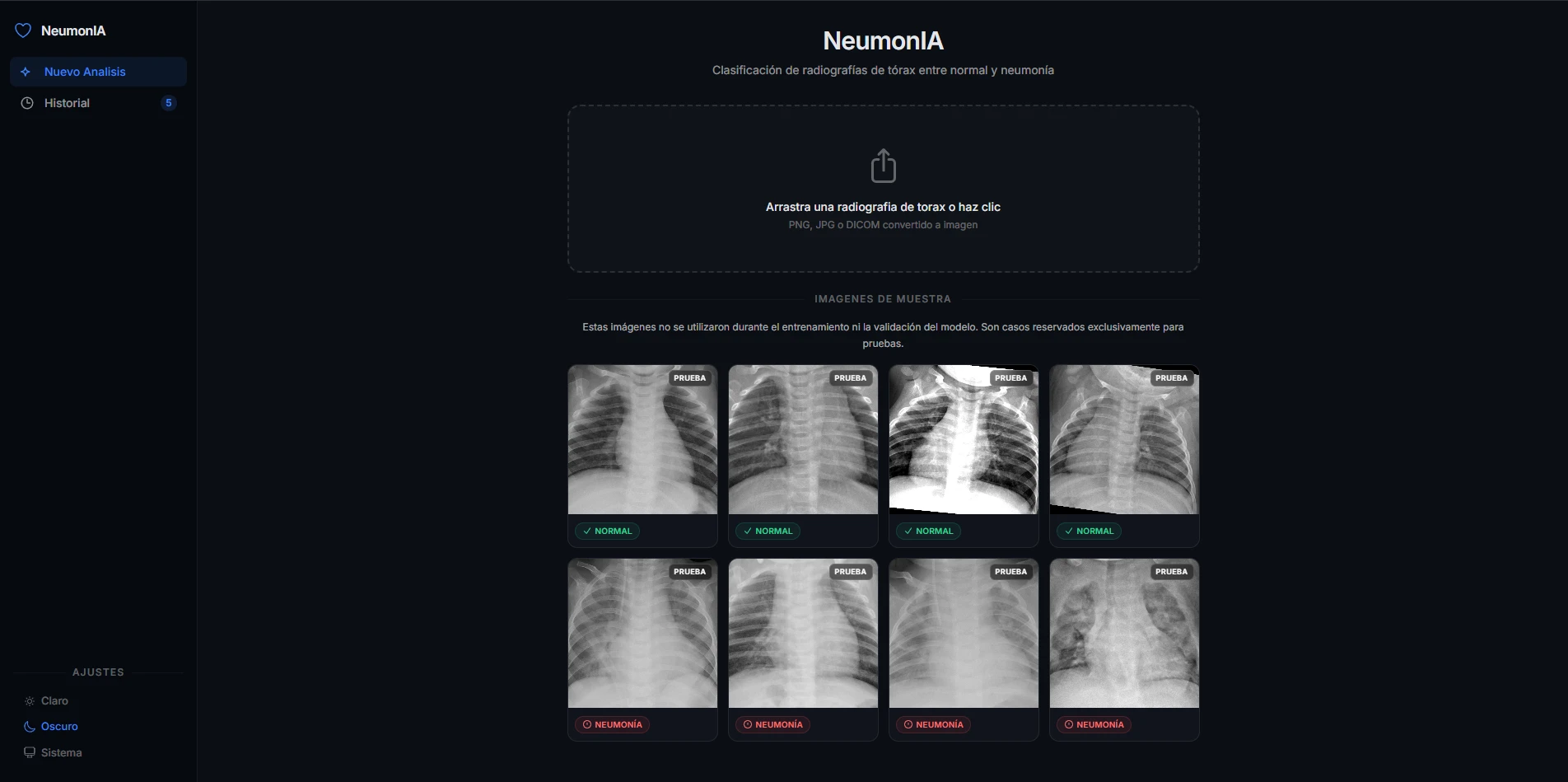
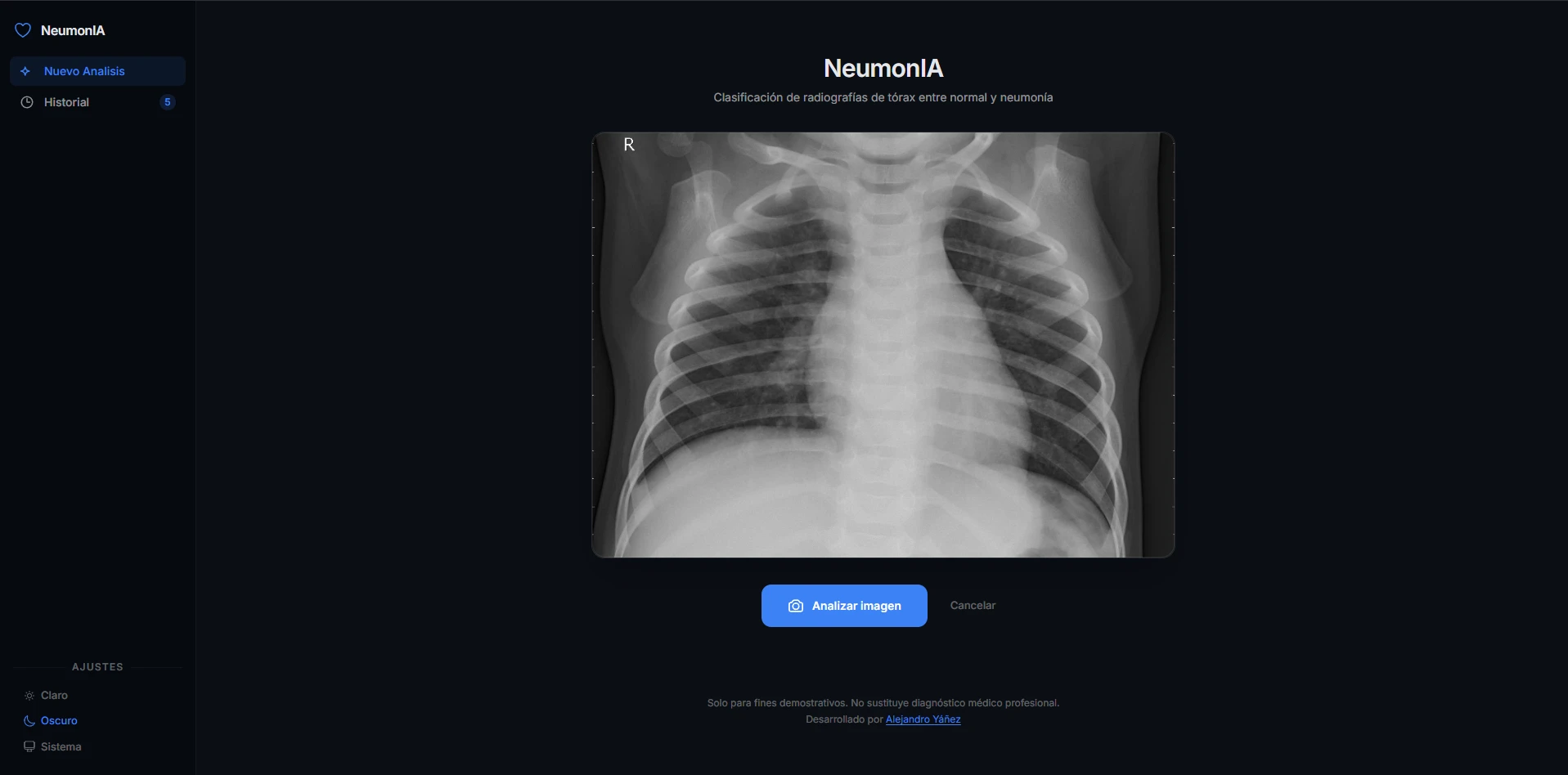
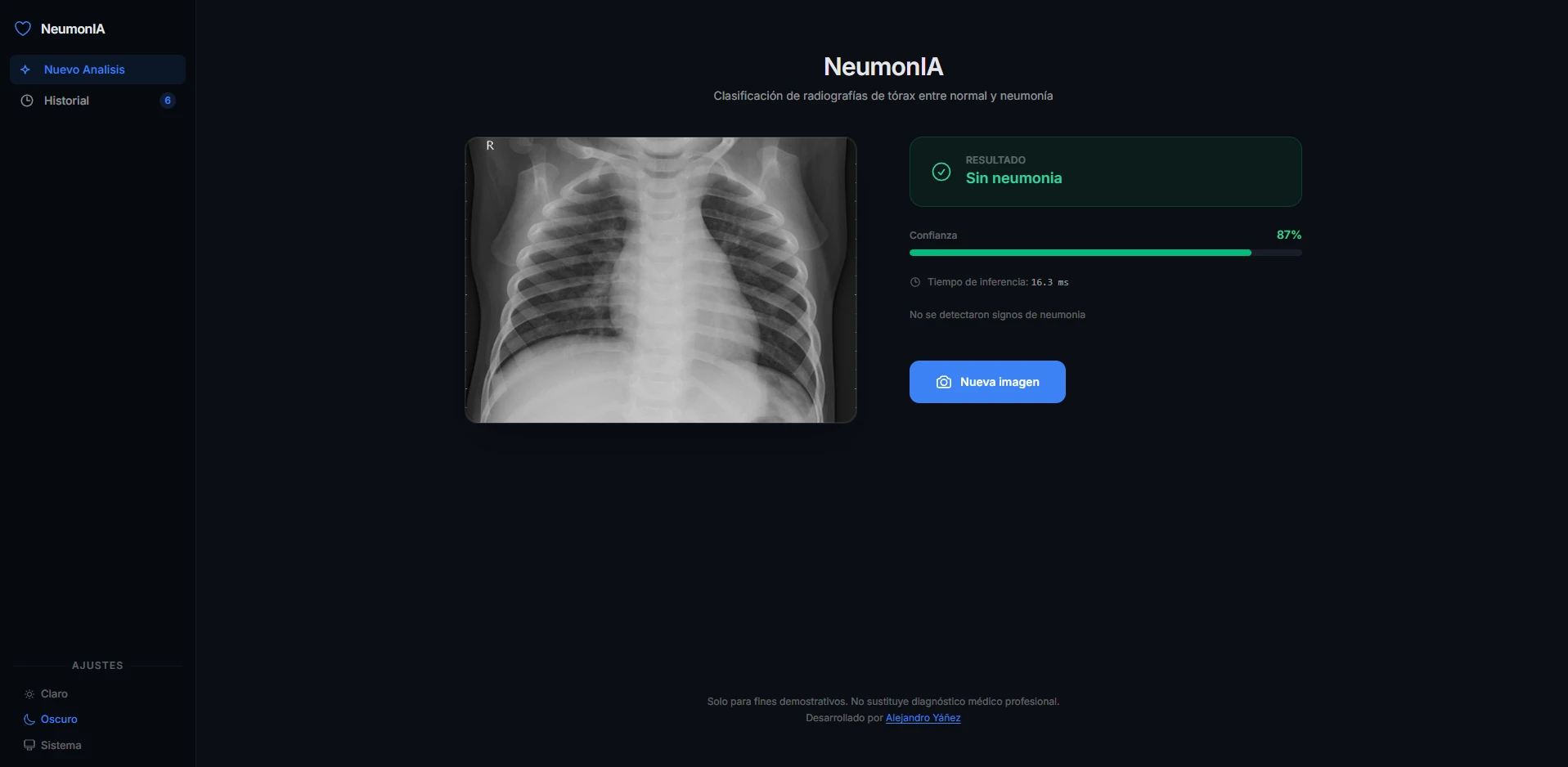
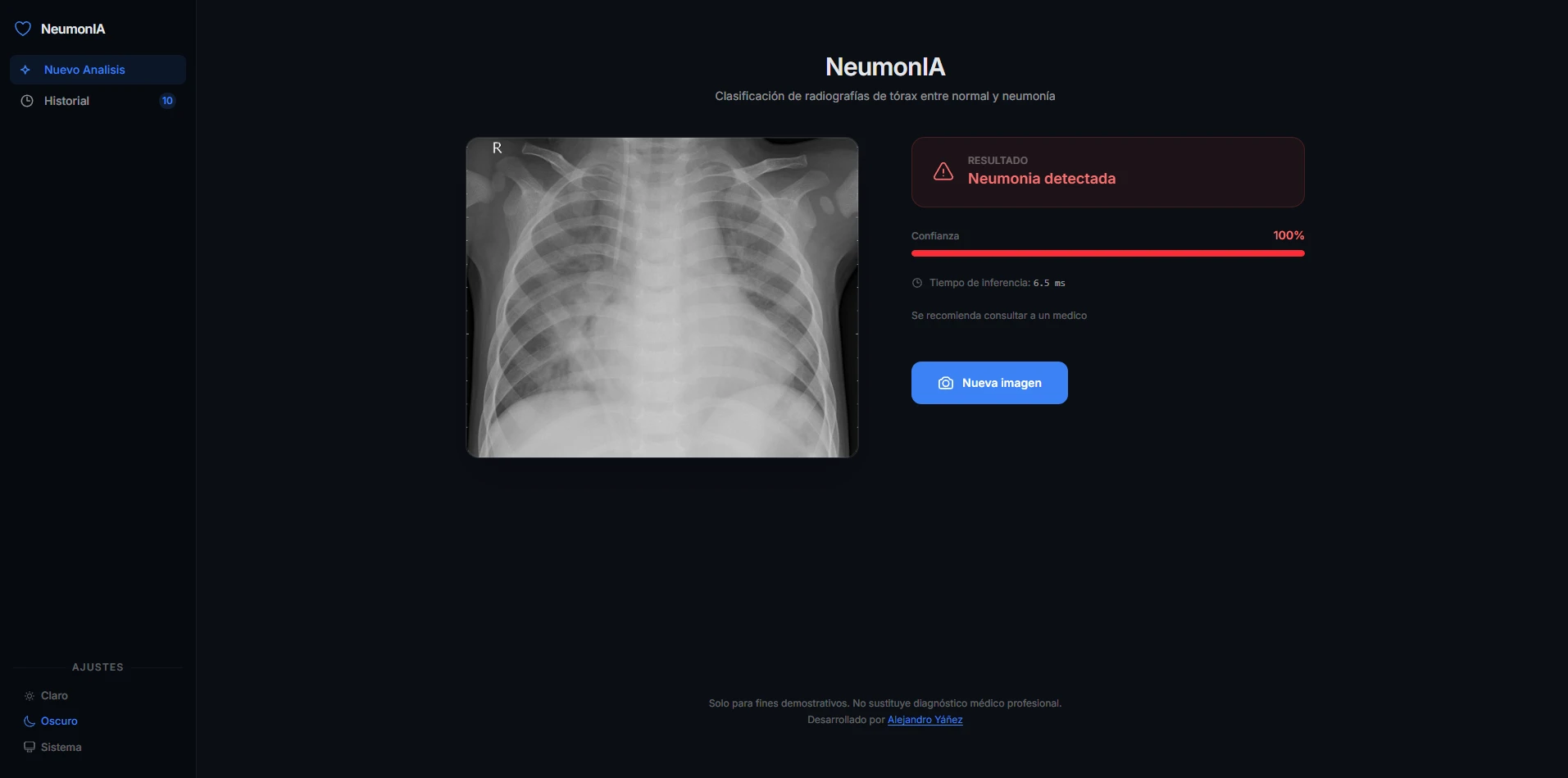
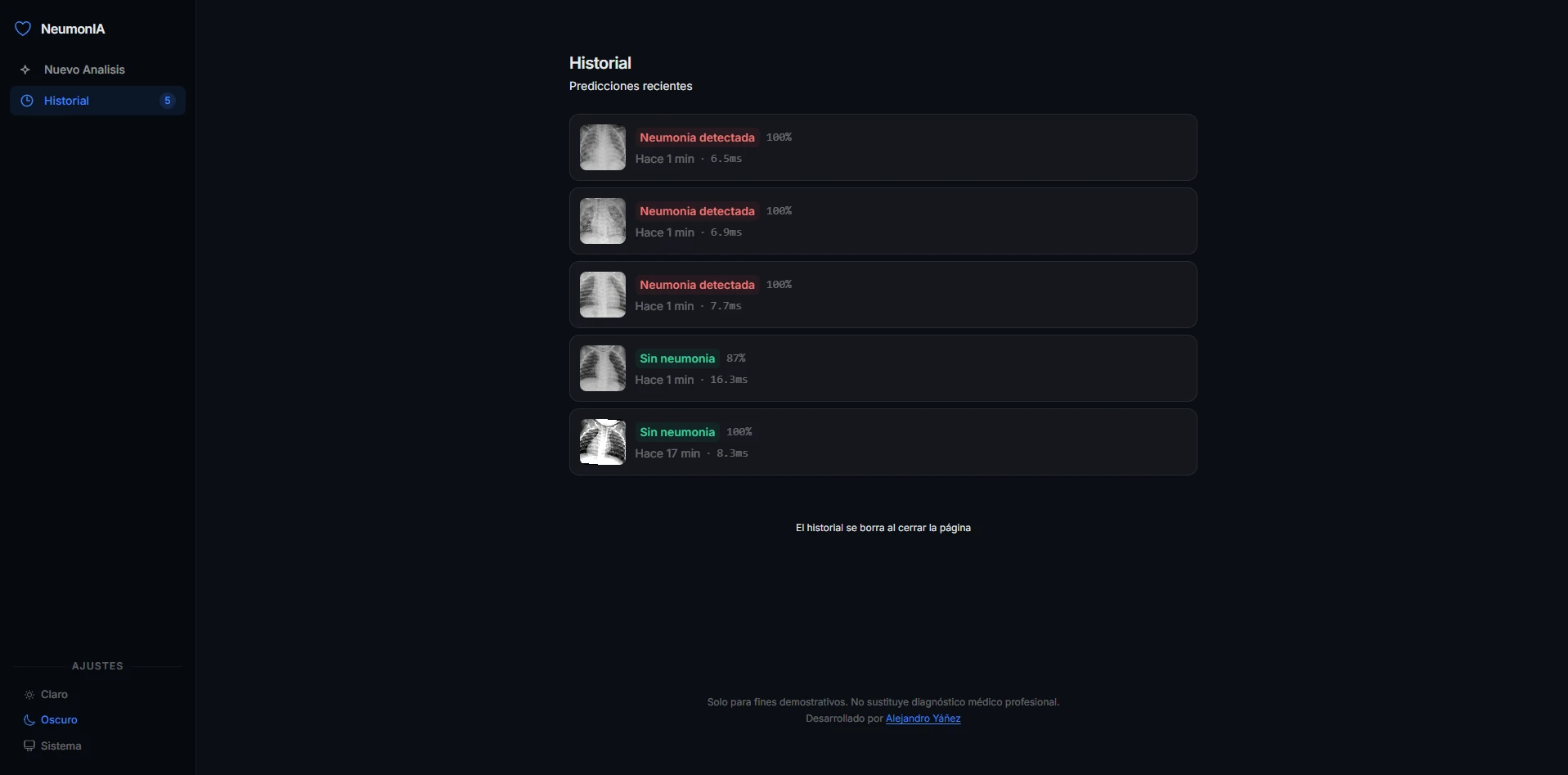
NeumonIA is a PWA that loads an image classification model in the browser via ONNX Runtime Web and performs inference entirely on the client side. The user drags in a chest X-ray; the model processes it in seconds and shows the result with confidence level and inference time.
Includes sample image gallery, prediction history, dark mode, responsive interface, and Spanish language support.
Technical Architecture
Model Training
The model was trained on Google Colab with an NVIDIA RTX PRO 6000 Blackwell GPU (97 GB VRAM). YOLO26n-cls (47 layers, 1.5M parameters) was used on the Chest X-Ray Pneumonia Balanced Dataset with 6,800 training and 1,700 validation images (balanced 50/50).
YOLO was chosen over building a custom CNN from scratch for three reasons:
- Native ONNX export via Ultralytics — essential for browser inference with
onnxruntime-web. - Compact footprint — YOLO26n-cls has only 1.5M parameters and produces a 5.9 MB ONNX file, keeping load times reasonable on the web.
- Proven classification head — YOLO’s
-clsvariant is purpose-built for image classification, avoiding the complexity of adapting a detection architecture.
This contrasts with the earlier Pneumonia Prediction project, which used DenseNet-201 (18M+ parameters) — a powerful but much heavier architecture. According to Ultralytics benchmarks, YOLO26n achieves just 1.7 ms latency on T4 TensorRT and 38.9 ms on CPU ONNX (up to 43% faster than its predecessor), so it suits real-time client-side inference.
| Hyperparameter | Value |
|---|---|
| Epochs | 150 (early stopping, patience=20) |
| Batch size | 512 |
| Image size | 224×224 |
| Learning rate | Cosine scheduler + AMP |
| Validation accuracy | 98.5% top-1 |
| Test accuracy | 100% (30/30 images) |
ONNX Export
The PyTorch checkpoint (3.0 MB) was exported to ONNX with opset 17, FP32 precision, and simplified graph. Final size is 5.9 MB, compatible with onnxruntime-web.
Browser Inference
The inference.ts class (126 lines) implements the pipeline in three phases:
- Model loading: cascading detection of WebGPU → WebGL → WASM to ensure compatibility with any modern browser.
- Preprocessing: the image is resized to 224×224 on a canvas, R, G, B channels are extracted separately, and organized in NCHW (planar) format as YOLO expects.
- Prediction: the tensor is fed to the ONNX session and two probabilities
[normal, pneumonia]are returned.
Vite Plugin for WASM Files
The biggest integration challenge was that onnxruntime-web requires 4 WASM files at runtime that Vite doesn’t serve automatically from node_modules. I wrote a custom plugin that:
- In development: serves
.wasmfiles withContent-Type: application/wasmheader - In production: copies WASM files to
dist/during build
Additionally, onnxruntime-web was excluded from optimizeDeps to prevent Vite from breaking WASM imports.
Frontend
- React 19.2 with custom hooks:
useModel(ONNX model lifecycle),useTheme(light/dark/system), anduseHistory(up to 50 in-memory predictions) - Router-less navigation:
useState<View>with conditional rendering to keep the bundle lightweight - Theme system: CSS custom properties on
:root,.dark, and@media (prefers-color-scheme: dark), persisted inlocalStorage - 14 components:
DropZone,SampleGallery,ImagePreview,ResultCard,ProgressBar,Sidebar,HistoryList, among others
Results
| Metric | Value |
|---|---|
| Top-1 accuracy (validation) | 98.5% |
| Top-1 accuracy (test) | 100.0% |
| WebGPU latency | ~5–20 ms |
| WebGL latency | ~20–80 ms |
| WASM latency | ~100–500 ms |
| ONNX model size | 5.88 MB |
| Model load time | ~2–8 s |
The model maintains perfect accuracy on the test set and performs real-time inference even on consumer hardware.
Challenges & Learnings
ONNX + Vite Integration
WASM files are not automatically resolved from node_modules. I fixed it by writing a custom plugin and excluding onnxruntime-web from Vite’s dependency pre-bundling.
Execution Provider Fallback
WebGPU is not yet universal. Cascading detection (WebGPU → WebGL → WASM) was essential to ensure functionality in any browser.
NCHW Preprocessing
YOLO expects channels in planar format (R plane, G plane, B plane), not interleaved. Manual implementation from getImageData() required care to maintain CPU performance.
Medical Context Design
The UI includes a visible disclaimer, confidence bar (not just binary verdict), and ephemeral in-memory history to avoid storing medical data without consent.
References
- Ultralytics — YOLO26n-cls. Official documentation.
- ONNX Runtime Web — API and usage guide.
- Kaggle — Chest X-Ray Pneumonia Balanced Dataset.
- ONNX — Opset 17 specification.
- Vite — Plugin API.
- WebGPU — W3C Specification.
- Tailwind CSS v4 — CSS-based configuration.