Anxiety Detection in Classrooms
Computer vision system based on YOLO11-pose to identify anxious states through student movement patterns in classrooms at Universidad del Bío-Bío.
Problem and Motivation
Despite the DDE’s extensive support catalog (clinical care, workshops, recreational activities), everything operates reactively. Anxiety has observable physical manifestations: self-touching gestures (rubbing the neck, touching the face) increase in frequency and duration under internal tension. The project coins the term “anxious state” to delimit the scope: it does not diagnose clinical anxiety; it detects transient body patterns.
A systematic review in Web of Science, Scopus, and IEEE Xplore (1,428 initial papers, 5 relevant after filters) revealed that no prior work addresses anxiety detection in classrooms through body postures.
Dataset Construction
Capture
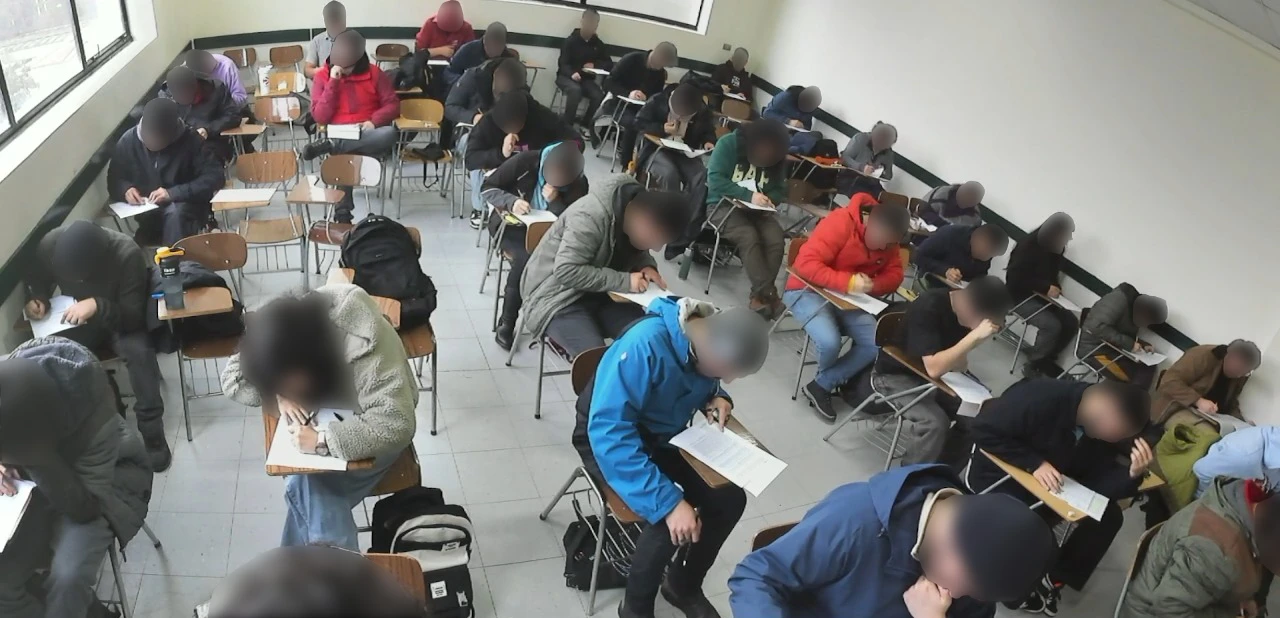
5 recording sessions in real UBB courses (~3 h of footage), with informed consents, face anonymization, and labeling in Roboflow.
Custom 16-keypoint Topology
Unlike the standard COCO topology (17 keypoints), the 5 facial points were unified into a single keypoint (head) to prioritize the relevant anatomical region (arms, hands, and head) over facial details.
| Keypoint | Description |
|---|---|
| 0 | Head |
| 1 | Neck |
| 2 | Left shoulder |
| 3 | Left elbow |
| 4 | Left hand |
| 5 | Right shoulder |
| 6 | Right elbow |
| 7 | Right hand |
| 8 | Central torso |
| 9 | Torso base |
| 10 | Left hip |
| 11 | Left knee |
| 12 | Left foot |
| 13 | Right hip |
| 14 | Right knee |
| 15 | Right foot |
Two classes to handle occlusion: person-full-body (16 kp visible) and person-half-body (only kp 0–9, torso upward). Labeling criteria: tight bounding box, keypoint occluded if its position can be inferred, removed if it cannot be inferred.
Dataset evolution:
| Version | Images | Instances | Contribution |
|---|---|---|---|
| v1 | 51 | 1,344 | Baseline |
| v2 | 51 | 2,838 | + augmentation (mosaic, mixup, erasing) |
| v3 | 70 | 4,344 | + unseen angles, variable lighting |
The dataset grew incrementally (51 → 61 → 70), and training stopped once convergence reached saturation. The high density (~36 students/image) compensates for the reduced volume: 4,300+ annotated skeletons.
Training: 4-Phase KDD Methodology
The project followed the KDD methodology (Fayyad et al., 1996), an iterative process that feeds findings back between phases. Each phase isolates a critical variable: architecture (F1), resolution (F2), data (F3), and hardware (F4).
| Phase | Setup | Main Finding |
|---|---|---|
| F1 | Nano/Small/Medium/Large at 640 px, dataset v1, 200 epochs, Tesla T4 | Box OK (~0.73) but Pose mAP50-95 ≤0.42. Spatial quantization error: at 640 px, distant students occupy very few pixels. The bottleneck is resolution, not network depth. |
| F2 | YOLO11s at 960 px + aggressive augmentation (mosaic, mixup, erasing, rotation, scaling, flip) | Pose mAP50-95 increases from 0.419 to 0.478 (+14%). Small (9.9M) outperforms Large (26.1M) with 62% fewer parameters. Half-body: +20%. Spatial resolution is more critical than depth. |
| F3 | YOLO11s at 960 px, dataset v3 (70 img, 4,344 instances) | Pose mAP50-95 reaches 0.521 (+9%). Half-body: 0.416 (+11%). Stable curves without divergence. Asymptotic convergence: the learning limit for this data volume was reached. |
| F4 | YOLO11l at 960 px, dataset v3, Google Colab Pro + NVIDIA A100 (40 GB VRAM) | Comparative benchmark on local GPU (RTX 3060). F1-Confidence calibration → optimal threshold = 0.393 (prioritizes sensitivity, delegates FP reduction to temporal filter). Final model selection. |
Inference System
Two-stage modular pipeline, decoupling GPU (extraction) from CPU (analysis):
Video → [Extraction: YOLO + ByteTrack + geometric logic] → CSV → [Analysis: temporal filter] → ReportStage 1 — Tracking and contact detection
ByteTrack assigns persistent IDs to each student even under occlusions (600-frame buffer). For each person, the pipeline extracts the 16 keypoints and applies geometric logic: it computes the torso length (neck → torso-base distance) as a scale reference and defines a dynamic threshold radius = torso × 0.5. If the distance from either hand to the head is less than that radius, touching_head = True is recorded. This mechanism automatically scales with student depth: a large torso in pixels (front row) generates a proportionally large radius; a small one (background) generates a small one. The criterion stays equivalent across the scene, preventing false positives/negatives due to perspective.
Results are stored in CSV (frame, timestamp, person_id, touching_head, torso_len, distances, 48 raw coordinates). Visual rendering is suppressed to prioritize processing speed.
Stage 2 — Temporal filtering and report
After completion, the analysis module segments data by person and detects blocks of consecutive frames with contact. Only events ≥ 2.0 seconds are considered, a threshold based on Shreve et al.: self-pacification gestures are sustained, not instantaneous touches. The output is a tabular report with student ID, number of anxious events, and cumulative total duration.
Inference hardware: NVIDIA RTX 3060 GPU (8 GB VRAM), AMD Ryzen 5 9600X CPU, 32 GB RAM. Local consumer hardware, no cloud dependency.
Results
| Phase | Model | Res. | Pose mAP50-95 (global) | Full-body | Half-body |
|---|---|---|---|---|---|
| 1 | YOLO11l | 640 | 0.419 | 0.526 | 0.312 |
| 2 | YOLO11s | 960 | 0.478 | 0.581 | 0.375 |
| 3 | YOLO11s | 960 | 0.521 | 0.626 | 0.416 |
| 4 | YOLO11l | 960 | 0.579 | 0.704 | 0.454 |
- Global progression: +38.19%.
- Full-body: +33.84%.
- Half-body: +45.51%.
The torso length histogram (~15 to ~95 px) validated the dynamic threshold’s adaptability. The 2 s filter eliminated postural noise (<1 s) and retained only events compatible with the anxious state. The model processes video at functional speed on the RTX 3060.
Libraries
| Library | Version |
|---|---|
| Ultralytics | 8.3.223 |
| torch | 2.9.0 |
| OpenCV | 4.12.0 |
| Pandas | 2.3.3 |
| Numpy | 2.2.6 |
| Roboflow | 1.2.11 |
| Matplotlib | 3.10.7 |
Conclusions
- Feasibility: the project demonstrated that detecting anxious states through HPE in real classrooms is feasible across the complete cycle: ethical data → iterative training → inference on consumer hardware.
- Class design: the full-body/half-body split was a well-founded decision that handled occlusion and drove metric progress.
- Dynamic threshold: the radius proportional to torso length correctly normalizes detection across different scene depths.
- Temporal filter: the 2 seconds of continuous contact bridge geometry with psychological interpretation and eliminate postural noise.
- Limitations: despite having over 4,300 labeled instances, these came from few images (70), captured in only two classrooms and from only two camera angles. This low visual variability limits the model’s ability to generalize pose estimation to new scenarios, furniture layouts, or unseen perspectives. Added to this are monocular resolution and the absence of concurrent clinical validation.
- Future work: streaming deployment with real-time alerts, multi-camera 3D estimation, incorporation of multimodal signals, and integration with DDE systems for consultation by mental health professionals.
References
- Shreve, E. G. et al. (1988). Nonverbal expressions of anxiety in physician-patient interactions. Psychiatry, 51(4).
- Cao, Z. et al. (2017). Realtime multi-person 2D pose estimation using part affinity fields. CVPR.
- Fayyad, U. et al. (1996). From data mining to knowledge discovery in databases. AI Magazine, 17(3).
- Ultralytics. (2025). YOLO11 Documentation. https://docs.ultralytics.com